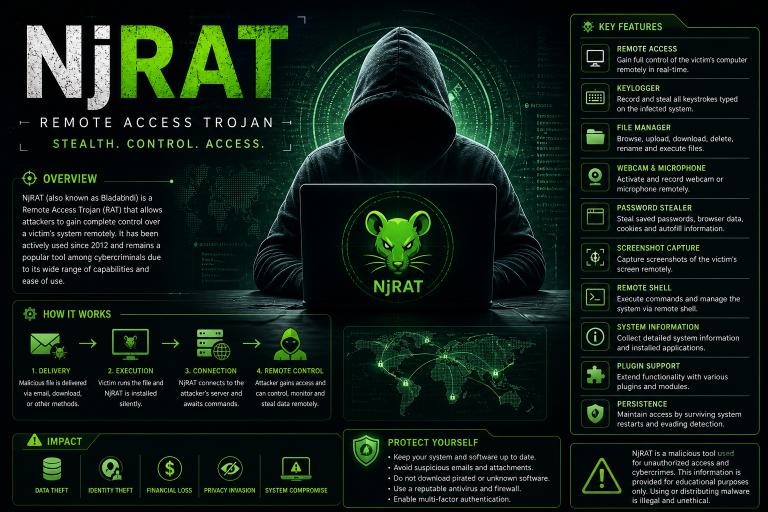
njRAT, also known as Bladabindi, is a widely known Remote Access Trojan (RAT) that targets Microsoft Windows systems. It allows a remote operator to control an infected computer through the internet, enabling unauthorized monitoring and data collection.
First discovered around 2012, NjRAT quickly became one of the most discussed malware families in cybersecurity research due to its accessibility and extensive capabilities. The malware is typically written using the .NET framework, which allows it to run efficiently on many Windows environments.
NjRAT is usually distributed through malicious email attachments, infected downloads, pirated software, or social engineering attacks. Once executed on a victim’s computer, it establishes communication with a command-and-control (C2) server controlled by the attacker. This connection enables the attacker to monitor system activity, extract sensitive information, and perform various remote operations.
Because of its flexible architecture and range of functions, NjRAT has been widely analyzed by cybersecurity researchers and is frequently used as an example when explaining how Remote Access Trojans operate.
Below are some of the commonly documented capabilities associated with njRAT.
NjRAT allows an operator to remotely control an infected machine, giving them access to system functions and files from anywhere through the internet.
The software can record keystrokes typed on the infected computer, enabling the capture of login credentials, messages, and other typed information.
Operators can remotely browse, upload, download, delete, or execute files on the infected system.
NjRAT can collect stored credentials from web browsers and applications, as well as extract other system information.
The malware can capture screenshots of the victim’s screen, allowing attackers to monitor user activity visually.
In some variants, NjRAT allows remote access to the webcam or microphone for surveillance purposes.
Attackers can execute commands on the infected system using remote shell functionality.
NjRAT can collect system details such as:
The malware may attempt to maintain long-term access by configuring itself to run automatically when the system starts.
Some versions support additional modules or plugins that extend its functionality.
There are no reviews yet.